Since the occupation tightened its full grip on every crossing that connects the Strip to the world, its hand reached even further to touch the toys of children. They are banned for no known reason, and when found, their prices are unimaginable never less than two hundred shekels. A father will even change his path, walking a longer street, just so he and his son don’t pass a toy shop afraid his boy will see something his father cannot afford to buy him. And you know what happens then: a small heartbreak, in a small heart that can do nothing about it.
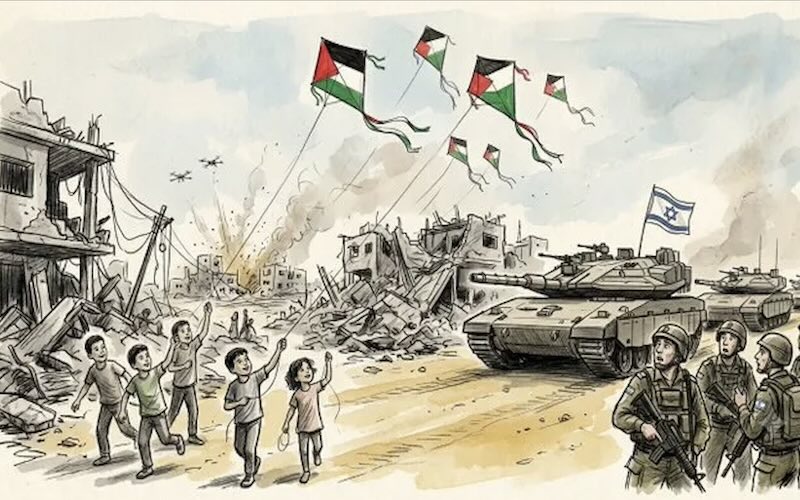
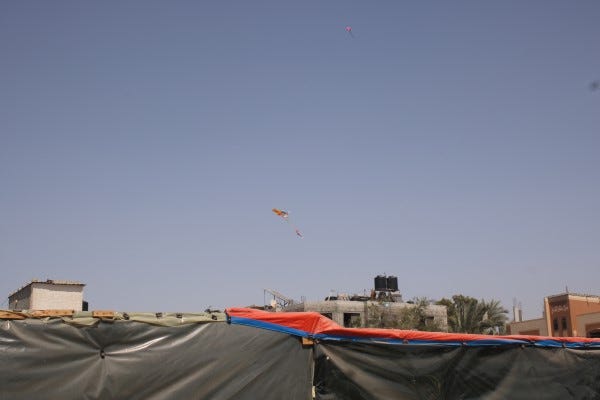
So the children make their own toys out of empty cola cans, scraps of wood, whatever is left. And when summer comes, their eyes turn to the sky, and they begin a long, tiring journey for just one paper kite: days spent searching for a wooden stick, a scrap of nylon, some paper; saving from their meager allowance to buy string; then begging the neighborhood’s “kite expert,” waiting with a child’s patience for him to build them a kite that might fly and might not, after all that longing.
And after all this small, humble effort, the occupation announces that it has discovered an “aircraft” not nuclear, just paper threatening its security. Meetings are convened, warnings are issued, homes are targeted, neighborhoods are evacuated all over a string and a piece of cloth. An army that bombs three countries sits its prime minister, defense minister, chief of staff, and top commanders down for an evening assessment meeting, to deliberate the danger of six sheets of paper. No missiles. No tunnels. No infiltration. Just paper flying on a string and for its sake, an entire army was put on alert.
The security establishment first described them as isolated incidents. Then, suddenly, they were given a “political label,” and orders went out to declare a state of emergency — to respond firmly to any launch, with threats to displace the residents of the areas the kites came from. Twenty-four hours were enough to promote a child’s toy to the rank of strategic threat, and the punishment for flying a kite became the displacement of an entire neighborhood. In the same statement, kites were blurred together with balloons and drones in one grand sentence, implying a danger that does not exist — and if paper truly carried what they claim, it would never have flown in the first place. But no one invited physics to that meeting.
Even the army’s own rules of engagement permit a response only in two situations, neither of which applies here so the easier path was to expand the definition of “weapon” rather than admit there was no threat to answer. Even one Israeli official himself asked: who said paper is a threat in the first place? But his question was lost in the noise. Netanyahu said he would not let anyone undermine his citizens’ sense of safety — and that sense of safety was undermined indeed, not by a missile, not by an incursion, but by paper and string, after three years of war, billions in budgets, and total air control. A state that needs to widen the definition of “weapon” to include a child’s toy is not telling us its enemy has grown more dangerous. It’s telling us it has tried everything else, and has nothing left but to “defeat” paper.
Refaat Alareer wrote: “A child, somewhere in Gaza, looks up at the sky, watches the kite rising higher, and for a moment believes it is an angel bringing love back.” This was all the kite ever meant to children children, more than twenty-one thousand of whom have been killed in just three years children who still clutch a long string and a scrap of cloth they turned into a kite, so they could play with it among the rubble. A long string, and wind and sometimes a string snaps and drifts toward settlements built on land that was theirs to begin with. And this innocent accident became an excuse to bomb what little remains of their homes.
And yet, the kite was never anything but a language of hope. In 2011, in a city sealed off on every side by walls and barbed wire like some vast open-air prison, children had no outlet but the sea or the sky. So they built, with their own hands, ten thousand nine hundred and ten paper kites, launched by fifteen thousand children at once on the beach breaking the world record. That same year, when the tsunami struck Japan, a Japanese man drew inspiration from Gaza’s story and launched a similar initiative in his own country. Gaza joined it, and the kites became a language spoken between the children of Gaza and the children of Japan, under the name “Kites of Hope.” During the First Intifada, children painted their kites in the colors of their flag. In 2020, they flew kites bearing the faces of friends killed by Israel in the May war. And during this genocide, when Refaat Alareer was martyred, his final wish became legend: that someone buy string and paper and build a kite so that a child in Gaza might see it, and for one moment, believe an angel had come to bring back love.
My little brother Karam says it best:
They took electricity and homes from us, so we lived in tents.They took our schools, so we studied in tents despite the danger.They took our food, so we lived on scraps.They took our water, so we stood in lines just to get enough.They took our right to play and when we made a kite from nylon and paper, they wanted to take that from us too.
And in Gaza today, the paper kite still bears witness to all of this. Not far from the site of a massacre that swallowed most of his family and left his small body streaked with blood as he was pulled from it, nine-year-old Taha Abu Nasser plays with a kite he built with his own hands, shaped like the Palestinian flag. That night, Taha lost his father, his uncles, and most of his cousins, when the bombing turned a five-story building home to dozens of displaced families into rubble. He and his mother were pulled out from beneath it, and she still suffers from her injuries to this day. Taha and his friends, more than twelve children, used to spend every summer playing football in the mornings and flying their kites in the evenings over the harvest fields. But this summer he is alone because everyone who once played beside him is now a martyr. And still, kites fill the sky above the displacement camps, where children race to see whose kite can climb the highest, and where mothers find, in that brief moment, their only escape from the weight of the tent, its heat, and the sleepless nights it forces on them. But this same game, which gives some children a moment of forgetting, has become for other children something closer to survival than play.
A child from #Gaza breaks his kite while crying and directs a message to Netanyahu and Katz, against the backdrop of the occupation’s threats to respond to the falling of kites in the settlements surrounding Gaza
Brothers Yazan and Amr, ten and eight years old, support a family of eight after their father was wounded and could no longer work. They spend their entire day cutting reed wood, gathering string and colored paper, building a kite for eight shekels and selling it for fifteen, moving from camp to camp in search of a buyer in an economy worn down by siege and displacement. And on another edge of this same picture sits a teacher who lost both his salary and his home, Abu Mohammed Al-Shawish, building his children kites out of notebook paper with no wood at all kites that fly only a short distance before dropping back to earth. Still, his children delight in them, even knowing they will never climb as high as the others’, because they have already learned, far too young, to understand the weight of what they are living through. This is what the paper kite has become in Gaza held between a child flying it to escape the memory of a massacre, a child building it to feed his siblings, and a father shaping it from a school notebook because it’s all he has left: a single string, by which the children of Gaza cling to a fragile hope, under a sky that shows them no mercy, even in their play.
Help me get my family out of there. Help me get them to safety.



 A child from #Gaza breaks his kite while crying and directs a message to Netanyahu and Katz, against the backdrop of the occupation’s threats to respond to the falling of kites in the settlements surrounding Gaza
 A child from #Gaza breaks his kite while crying and directs a message to Netanyahu and Katz, against the backdrop of the occupation’s threats to respond to the falling of kites in the settlements surrounding Gaza